
The Leaders' Debates Commission's 2025-26 Departmental results report
On this page
- At a glance
- From the Executive Director
- Results: what we achieved
- Spending and human resources
- Supplementary information tables
- Federal tax expenditures
- Corporate information
- Definitions
Copyright information
© His Majesty the King in Right of Canada, as represented by the Minister of Transport and Leader of the Government in the House of Commons, 2026
Catalogue Number: CP35-1E-PDF
ISSN: 2816-8925
At a glance
This departmental results report details the Leaders' Debates Commission's actual accomplishments against the plans, priorities and expected results outlined in its 2025–26 Departmental Plan.
These results align with the priorities outlined in the May 21, 2025, mandate letter from the Prime Minister, as well as with Leaders' Debates Commission's vision, mission, raison d'être and operating context which is to organize two leaders' debates during each federal general election – one in each official language.
Key priorities
The Leaders' Debates Commission identified the following key priorities for 2025–26:
- Organizing two leaders' debates in the next federal general election, one in each official language
- Promoting awareness of, and access to, the leaders' debates
- Preparing a final report to Parliament, following the debates, outlining findings, lessons learned, and recommendations
Highlights
Organizing two leaders' debates in the 2025 federal general election
The Leaders' Debates Commission organized two leaders' debates, one in each official language, during the 2025 federal general election in accordance with its mandate and core responsibility.
A federal general election took place on April 28, 2025, with the French-language leaders' debate held on Wednesday, April 16, 2025, and the English-language leaders' debate on Thursday, April 17, 2025.
Both debates were held prior to the advance voting period, during which an increasing number of electors cast their ballots: advance voting participation was 25% higher in the 2025 federal general election than in the 2021 federal general election.Footnote 1
The 2025 leaders' debates were successful in serving the public interest and the voting public, with both the format and moderation receiving broad acclaim. Public feedback described these democratic exercises as excellent, effective, and informative.
Promoting awareness of, and access to, the leaders' debates
Viewership reached the highest level on record, with 19.4 million Canadians tuning in to watch the two debates in 2025, surpassing previous election campaigns, including those in 2015 and 2011.
The English and French-language debates were widely distributed. They were available live through 34 television outlets, 10 radio networks and 60 digital streams. Each debate was also accessible in 13 additional languages, including five Indigenous languages, American Sign Language (ASL), and Langue des signes québécoise (LSQ). Multilingual broadcaster OMNI Television provided interpretation in six additional languages. Both debates were also available with closed captioning and described video. The debates were broadcast internationally as well, attracting significant international interest.
Preparing a final report to Parliament
In accordance with its mandate, the Commission prepared a final report to Parliament following the 2025 federal general election, outlining findings, lessons learned, and recommendations. The report was tabled in the House of Commons on October 3, 2025, and in the Senate on October 21, 2025.
The Commission engaged with a wide range of stakeholders — both within Canada and internationally — to gather diverse perspectives for this report.
Consultations included discussions with debate moderators, television network executives, political parties, and media associations. The Commission also engaged with experts in governance, public opinion research, and journalism. Internationally, the Commission participated in a symposium with professionals experienced in the production and organization of political debates, from whom valuable insights were gained.
Public feedback played a central role. The Commission received more than 5,000 individual submissions from Canadians. It once again worked with the Consortium on Electoral Democracy (C-DEM) and the Canadian Election Study (CES) to survey Canadians on what makes successful debates. Collaborations also occurred with the team at the Media Ecosystem Observatory (MEO) — an interdisciplinary initiative between McGill University and the University of Toronto that studies the health of media ecosystems — to survey Canadians about the 2025 leaders' debates.
- Total actual spending (including internal services): $2,113,251
- Total full-time equivalent staff (including internal services): 2.0
For detailed information on the Leaders' Debates Commission's total spending and human resources, read the Spending and human resources section of this report.
Summary of results
The following provides a summary of the results the department achieved in 2025–26 under its "core responsibility" (its main area of activity).
Core responsibility: Organize Leaders' Debates for federal general elections
Actual spending: $2,113,251
Actual human resources: 2.0
In 2025-26, the Commission's mandate and core responsibility was to organize two leaders' debates in the 2025 federal general election - one in each official language - that were effective, informative, and compelling, served the public interest, and reached as many Canadians as possible.
The 2025 leaders' debates were successful in serving the voting public, with both the format and moderation receiving broad acclaim. Public feedback described these democratic exercises as excellent, effective and informative.
Viewership reached the highest level on record, with 19.4 million Canadians tuning in to watch the two debates in 2025, surpassing previous election campaigns, including those in 2015 and 2011.
For more information on the Leaders' Debates Commission's activities related to organizing Leaders' Debates for federal general elections, read the "Results: What we achieved" section of this report.
From the Executive Director

The Commission was created in the lead up to the 2019 federal general election by Order in Council P.C. 2018-1322 and amended by OIC P.C. 2020-0871 and 2024-0598. Our core responsibility is to organize leaders' debates during each federal general election – one in each official language.
In accordance with our mandate, the Commission organized leaders' debates in the 2019, 2021 and 2025 general elections, with the April 2025 federal election marking the third cycle in which the Commission organized leaders' debates.
Since its inception, the Commission has contributed to strengthening Canada's democratic infrastructure by providing greater stability to the debate environment. Federal leaders' debates have been held in every general election since 2019 and are now a standard feature of every campaign. All invited party leaders participated in the debates in 2019, 2021 and 2025, and Canadians now expect debates to take place during every federal general election.
Debates play an essential role in Canada's democracy. They are democratic exercises that belong to the voting public. Serving the public interest means helping voters make informed choices at the ballot box. Debates should foster an exchange of policy positions that sheds light on the leaders' character and leadership abilities.
In our 2025 report to Parliament, we noted that the Commission introduced several key changes to better serve the public interest ahead of the debates, replacing the panel of journalists with a single moderator, adopting a simpler and more flexible format that encouraged exchanges between the leaders and simplifying the set and production design to keep the focus on the leaders and on the content of the debate.
The results confirmed that this was the right approach. The 2025 leaders' debates were successful in serving voters, with both the format and moderation receiving broad acclaim. Public feedback described them as excellent, effective and informative.
Viewership reached the highest level on record, with 19.4 million Canadians tuning in to watch the two debates in 2025, surpassing previous campaigns, including those in 2015 and 2011.
There was also greater reach and accessibility. In 2025, the English- and French-language debates aired on 34 television outlets, 10 radio networks and 60 digital streams. They were available in 13 additional languages, including five Indigenous languages, as well as in American Sign Language (ASL), and Langue des signes québécoise (LSQ). Multilingual broadcaster OMNI provided interpretation in six additional languages. The debates were also available with closed captioning and described video. International interest was significant, with BBC News, C-SPAN, TV5Monde, Eurovision and Reuters each bringing the debates to their respective audiences.
I have been privileged to serve as Acting Debates Commissioner for the Leaders' Debates Commission and work with a small, dedicated team, our Advisory Board, and a broad range of partners and stakeholders to deliver successful leaders' debates in 2025.
The Commission's 2025-26 Departmental Results Report, which follows, describes how the Commission worked to deliver on its mandate to organize leaders' debates and serve the public interest.
Michel Cormier,
Executive Director
Results: What we achieved
Core responsibilities and internal services
Core responsibility: Organize leaders' debates for federal general elections
In this section
Description
Core Responsibility: Organize Leaders' Debates for federal general elections
In order to execute its core responsibility to organize leaders' debates for federal general elections, the Commission issues a Request for Proposal regarding the production, distribution and promotion of the leaders' debates, enters into a contract with a debates producer, sets participation criteria for the leaders' debates and ensures that the leader of each political party that meets those criteria is invited to participate in the debates and makes them public, ensures that the leaders' debates are available in languages other than French and English, and, in doing so, pay special attention to Canada's Indigenous languages, and ensures debates are distributed free of charge, reach as many Canadians as possible and ensures that Canadians have access to the debates.
Quality of life impacts
The domain(s) and indicator(s) from the Quality of Life Framework for Canada that relate most closely to the Leaders' Debates Commission's core responsibility of organizing leaders' debates for federal general elections, is as follows:
- The Commission's core responsibility contributes to the Good Governance domain of the Quality of Life Framework for Canada and, more specifically, "Confidence in institutions," through all of the activities mentioned in the core responsibility description.
Progress on results
This section details the department's performance against its targets for each departmental result under Core responsibility: organize leaders' debates for federal general elections.
Table 1 shows the target, the date to achieve the target and the actual result for each indicator under Canadians are aware of and have access to debates organized by the Leaders' Debates Commission in the last three fiscal years.
| Departmental result indicators | Target | Date to achieve target | Actual results |
|---|---|---|---|
| Number of Canadians who have access to debates organized by the Leaders' Debates Commission | The proportion of Canadians having access to debates organized by the Leaders' Debates Commission exceeds comparable figures from the previous elections | March 2026 | 2023–24: N/A1 2024–25: N/A1 2025–26: English debate2 39,108,281 French debate2 39,108,281 |
| Number of Canadians who view debates organized by the Leaders' Debates Commission | The proportion of Canadians viewing the debates organized by the Leaders' Debates Commission exceeds comparable figures from the previous elections | March 2026 | 2023–24: N/A1 2024–25: N/A1 2025–26: English debate 12,423,204 French debate 7,024,984 |
Notes:
- No federal general elections were held in 2023-24 and 2024-25. Consequently, no leaders' debates were organized in those fiscal years.
- This figure has been calculated using Statistics Canada data from its 2022 Canadian Internet Use Survey, which indicated that 94% of Canadians had home Internet access, as well as Q2 2025 population figures from Statistics Canada. Both the English and French debates were available on the Internet.
The Results section of the Infographic for the Leaders' Debates Commission on GC Infobase provides additional information on results and performance related to its program inventory.
Details on results
The following section describes the results for organizing leaders' debates for federal general elections in 2025–26 compared with the planned results set out in the Leaders' Debates Commission's departmental plan for the year.
Canadians are aware of and have access to debates organized by the Leaders' Debates Commission
Results achieved
In 2025-26, the Commission's mandate and core responsibility was to organize two leaders' debates in the 2025 federal general election - one in each official language - that were effective, informative, compelling, served the public interest, and reached as many Canadians as possible.
To fulfill its mandate, the Commission issued a Request for Proposal (RFP) for a debates producer in July 2024, which outlined the promotion, production and distribution requirements for the next leaders' debates and identified what would best serve the public interest:
- a simple format that encourages meaningful exchanges between the leaders, helps Canadians learn about their policy positions and party platforms and sheds light on the leaders' character;
- one moderator for each debate — an experienced journalist — with no other journalists or hosts on stage; and
- a simple and intimate set and production design that keeps the focus on the leaders and on the content of the debate.
The Commission included in the RFP a format template that established the foundational structure for the debates and identified key format principles for the debates producer. In 2025, the debates producer endorsed these principles.
The Commission also developed formal moderator selection criteria for the first time since federal leaders' debates began in 1968. These criteria, outlined in the RFP, defined the moderator's role, responsibilities and essential attributes. The debates producer contracted by the Commission selected each moderator according to these criteria.
In 2025, the debates producer designed a simple and intimate set and production, which drew strong praise.
Ensuring the leaders' debates are effective, informative, and compelling, and serve the public interest
The most objective and measurable indicator for evaluating a debate's effectiveness is audience reach. In the three election cycles during which the Commission has organized debates, viewership reached unprecedented levels, surpassing those of the 2015 and 2011 election campaigns.
- In 2025, the two debates drew 19.4 million viewers, the highest audience figure on record.
- In 2025, more Canadians watched the debates than in 2021 and 2019, and more viewed the entirety of the two-hour leaders' debates than in 2021.
Public feedback received after the 2025 general election was positive, with Canadians describing the debates as excellent, effective and informative.
- Public opinion research from the Electoral Democracy (C-DEM) and Canadian Election Study (CES) reported that Canadians surveyed indicated that:
- their two primary goals for the debates — understanding party policies and platforms and enabling informed voting decisions — had been achieved.
- over 62 per cent of respondents said the debates exposed them to new ideas, finding them useful and valuable for Canadian society.
- a clear majority supported the approach taken — namely, flexible time management, natural flow and open exchanges — favouring a format that allows leaders to complete their points and enables substantive discussions that highlight differences in policy positions.
- Focus groups responses collected by C-DEM and CES echoed the sentiment that the debates were well done and relevant to Canadians.
- There was unanimous agreement among the range of stakeholders consulted for the 2025 report that the debates delivered for Canadians. The tone of the debates was widely described as substantive, civil and informative, making them both compelling to watch and valuable to the democratic process.
In the 2025 report, the Commission noted that there was unanimous agreement among the public, media and stakeholders consulted that the moderation of both the French and English debates was highly effective. In 2025, the moderation was central to the success of the debates.
- A survey on the 2025 leaders' debates by the Media Ecosystem Observatory - an interdisciplinary initiative between McGill University and the University of Toronto that studies the health of media ecosystems - revealed that 82 per cent of respondents viewed a single moderator as effective.
- C‑DEM and CES focus groups participants said the moderators were experienced and neutral, asked appropriate questions, and treated the leaders fairly and respectfully, allowing them to remain in the spotlight.
Delivery of the leaders' debates was also well within the contracted budget.
Ensuring the leaders' debates reach all Canadians
Making the debate signal free for distribution has significantly increased reach. In 2025, the debates producer provided the signal to multiple media partners, thereby expanding overall reach and impact.
In 2025, the English-language and French-language debates were:
- available live on 34 television outlets, 10 radio networks and 60 digital streams;
- accessible in 13 additional languages, including five Indigenous languages, alongside American Sign Language (ASL), Langue des signes québécoise (LSQ)
- offered with closed captioning and described video;
- supported by multilingual broadcaster OMNI Television, which provided interpretation in an additional six languages; and
- broadcast internationally by BBC News, C-SPAN, TV5 Monde, Eurovision, and Reuters, extending the debates' reach to audiences in the United States and around the world.
In the 2025 report, the Commission noted that this inclusive approach fostered deeper engagement from communities that are often marginalized in the political process. This unprecedented level of reach and accessibility elevated the debates into a centerpiece of the election campaign. The extensive network of distribution partners ensured that the debates had maximum impact as a major televised, streaming and online event.
Resources required to achieve results
Table 2 provides a summary of the planned and actual spending and full-time equivalents required to achieve results.
| Resource | Planned | Actual |
|---|---|---|
| Spending | 3,522,889 | 2,113,251 |
| Full-time equivalents | 4.0 | 2.0 |
The Finances section of the Infographic for the Leaders' Debates Commission on GC Infobase page and the People section of the Infographic for the Leaders' Debates Commission on GC Infobase page provide complete financial and human resources information related to its program inventory.
Related government priorities
This section highlights government priorities that are being addressed through this core responsibility.
Gender-based Analysis Plus
The Leaders' Debates Commission continued to advance the application of GBA Plus considerations through its mandate by organizing leaders' debates for general elections, one in each official language, and by ensuring that they reached as many Canadians as possible and were accessible and inclusive for persons with disabilities, people living in remote areas, and people living in official language minority communities.
Making the debates signal free of charge for distribution enabled multiple media partners to broadcast and share the debates, increasing their reach and accessibility. Never before have federal election debates drawn in Canadian audiences in such significant numbers as in 2019, 2021 and 2025.
Enhancing accessibility over the last three election cycles has ensured that debates reach as many Canadians as possible while enabling voters to watch, listen to or read the debates in the language and format most accessible to them. This inclusive approach has fostered engagement in communities on the margins of political involvement and deepened adhesion to these democratic exercises and the democratic process.
In 2025, the English-language and French-language debates were:
- available live on 34 television outlets, 10 radio networks and 60 digital streams;
- accessible in 13 additional languages, including five Indigenous languages, alongside American Sign Language (ASL), Langue des signes québécoise (LSQ)
- offered with closed captioning and described video;
- supported by multilingual broadcaster OMNI Television, which provided interpretation in an additional six languages; and
- broadcast internationally by BBC News, C-SPAN, TV5 Monde, Eurovision, and Reuters, extending the debates' reach to audiences in the United States and around the world.
Program inventory
Organizing leaders' debates for federal general elections is supported by the following programs:
- Leaders' Debates
Additional information related to the program inventory for organizing leaders' debates for federal general elections is available on the Results page on GC InfoBase.
Internal services
In this section
Description
Internal services are the activities and resources that support a department in meeting its corporate obligations and delivering its programs. The 10 categories of internal services are:
- acquisition management services
- communications services
- financial management services
- human resources management services
- information management services
- information technology services
- legal services
- material management services
- management and oversight services
- real property management services
Progress on results
This section presents details on how the department performed to achieve results and meet targets for internal services.
Internal Services functions were provided to the Commission by the Privy Council Office (PCO) through a Memorandum of Understanding between the two parties covering the 2025–26 fiscal year.
Resources required to achieve results
Table 3 provides a summary of the planned and actual spending and full-time equivalents required to achieve results.
| Resource | Planned | Actual |
|---|---|---|
| Spending | 0 | 0 |
| Full-time equivalents | 0 | 0 |
The Finances section of the Infographic for the Leaders' Debates Commission on GC Infobase and the People section of the Infographic for the Leaders' Debates Commission on GC Infobase provide complete financial and human resources information related to its program inventory.
Contracts awarded to Indigenous businesses
Government of Canada departments are required to award at least 5% of the total value of contracts to Indigenous businesses every year.
As shown in Table 4, the Leaders' Debates Commission awarded 5.10% of the total value of all contracts to Indigenous businesses for the fiscal year.
| Contracting performance indicator | 2025–26 result |
|---|---|
| Total value of contracts awarded to Indigenous businesses (A) | $9,653.24 |
| Total value of contracts awarded to Indigenous and non‑Indigenous businesses (B) | $189,359.41 |
| Value of exceptions approved by deputy head (C) | $0 |
| Proportion of contracts awarded to Indigenous businesses [A / (B−C) × 100] | 5.10% |
| Notes For the purposes of the minimum 5% target, Indigenous Services Canada defines "Indigenous businesses" as:
|
|
In its 2025-26 Departmental Plan, the Leaders' Debates Commission estimated that it would award 5% of the total value of its contracts in 2025-26 to Indigenous businesses. In fiscal year 2025-26, the Leaders' Debates Commission achieved this target, awarding 5.10% of its total expenditures to Indigenous businesses.
Spending and human resources
In this section
Spending
This section presents an overview of the department's actual and planned expenditures from 2023–24 to 2028–29.
Budgetary performance summary
Table 5 shows the money that the Leaders' Debates Commission spent in each of the past three years on its core responsibilities and on internal services.
| Core responsibilities and internal services | 2025–26 Main Estimates | 2025–26 total authorities available for use | Actual spending over three years (authorities used) |
|---|---|---|---|
| Organize Leaders' Debates for Federal General Elections | 3,522,889 | 3,486,001 |
|
| Subtotal | $3,522,889 | $3,486,001 |
|
| Internal services | 0 | 0 |
|
| Total | 3,522,889 | 3,486,001 |
|
Analysis of the past three years of spending
Actual spending was lower in 2023-24 and 2024-25, as these were non-election years.
Actual spending increased in 2025-26 due to the delivery of the Commission's core responsibility to organize leaders' debates during the 2025 federal general election.
Actual spending was lower than planned spending in 2025-26 mainly due to lower debates production costs and efficiencies realized in 2025-26 due to the timing of the federal general election at the beginning of the fiscal year, with preparatory activities undertaken in the previous fiscal year.
The Finances section of the Infographic for the Leaders' Debates Commission on GC Infobase provides more financial information from previous years.
Planned spending for next three years
Table 6 shows the Leaders' Debates Commission's planned spending for each of the next three years on its core responsibilities and on internal services.
| Core responsibilities and internal services | 2026–27 planned spending | 2027–28 planned spending | 2028–29 planned spending |
|---|---|---|---|
| Organize Leaders' Debates for Federal General Elections | 3,030,623 | 3,049,854 | 3,047,673 |
| Subtotal | 3,030,623 | 3,049,854 | 3,047,673 |
| Internal services | 0 | 0 | 0 |
| Total | 3,030,623 | 3,049,854 | 3,047,673 |
Analysis of the next three years of planned spending
The 2026-27, 2027-28 and 2028-29 planned spending in the next three fiscal years represents planned spending that is accessible to organize leaders' debates for federal general elections in an election year. The planned spending for the next three fiscal years includes an amount of $2.3 million that only becomes available in an election year when a federal general election is called. In fiscal years when no federal general election is held, the $2.3 million remains frozen and is not available for use.
The Finances section of the Infographic for the Leaders' Debates Commission on GC Infobase provides more detailed financial information related to future years.
Funding
This section provides an overview of the department's voted and statutory funding for its core responsibilities and for internal services
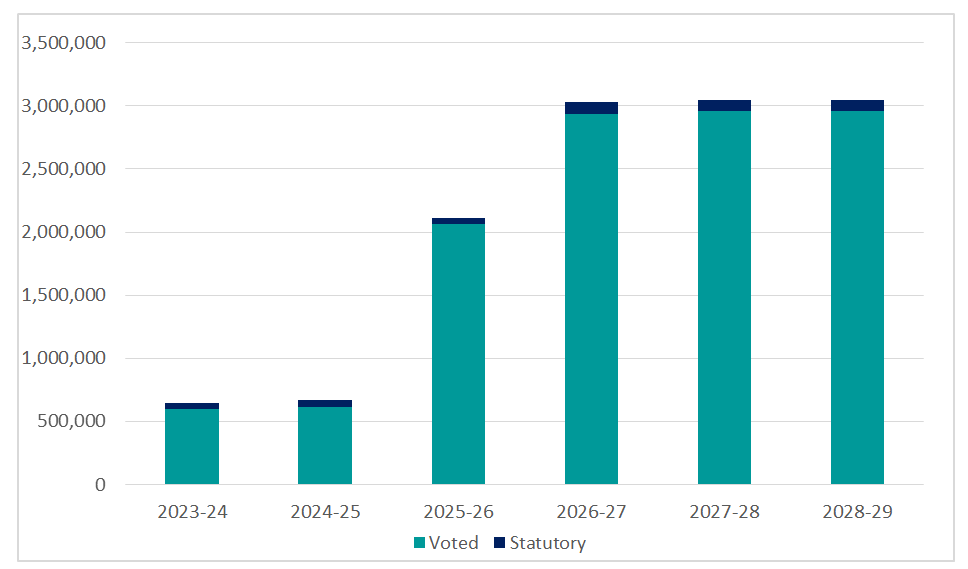
Graph 7 summarizes the department's approved voted and statutory funding from 2023–24 to 2028–29.
Graph 7: Approved funding (statutory and voted) over a six-year period
Text description
| Fiscal year | Statutory | Voted | Total |
|---|---|---|---|
| 2023–24 | $48,834 | $594,813 | $643,647 |
| 2024–25 | $52,569 | $616,660 | $669,229 |
| 2025–26 | $52,250 | $2,061,001 | $2,113,251 |
| 2026–27 | $91,759 | $2,938,864 | $3,030,623 |
| 2027–28 | $92,054 | $2,957,800 | $3,049,854 |
| 2028–29 | $91,465 | $2,956,208 | $3,047,673 |
Analysis of statutory and voted funding over a six-year period
Graph 7 above illustrates the Commission's spending trend over a six-year period (2023-24 to 2028-29).
Fiscal years 2023-24, 2024-25 and 2025-26 show actual expenditures, while 2026-27, 2027-28 and 2028-29 represent planned spending that is accessible to organize leaders' debates for federal general elections in an election year.
Actual spending was lower in 2023-24 and 2024-25, as these were non-election years.
Actual spending increased in 2025-26 due to the delivery of the Commission's core responsibility to organize leaders' debates during the 2025 federal general election.
The planned spending for 2026-27, 2027-28 and 2028-29 includes an amount of $2.3 million that only becomes available in an election year when a federal general election is called. In fiscal years when no federal general election is held, the $2.3 million remains frozen and is not available for use.
Consult the Public Accounts of Canada for further information on the Leaders' Debates Commission's departmental voted and statutory expenditures.
Financial statement highlights
This section presents the Leaders' Debates Commission's Financial statements (unaudited) for the year ended March 31, 2026.
Table 8 summarizes the expenses and revenues for 2025–26, which net to the cost of operations before government funding and transfers.
| Financial information | 2025–26 actual results | 2025–26 planned results | Difference (actual results minus planned) |
|---|---|---|---|
| Total expenses | $ 2,125,020 | $3,539,901 | ($1,414,881) |
| Total revenues | $0 | $0 | $0 |
| Net cost of operations before government funding and transfers | $2,125,020 | $3,539,901 | ($1,414,881) |
Analysis of expenses and revenues for 2025–26
The difference between the 2025-26 planned results and the 2025-26 actual results is attributable to the actual expenditures related to the delivery of the Commission's core responsibility to organize leaders' debates during the 2025 federal general election.
The 2025–26 planned results information is provided in the Leaders' Debates Commission's Future-Oriented Statement of Operations and Notes 2025–26.
Table 9 summarizes actual expenses and revenues and shows the net cost of operations before government funding and transfers.
| Financial information | 2025–26 actual results | 2024–25 actual results | Difference (2025–26 minus 2024–25) |
|---|---|---|---|
| Total expenses | $ 2,125,020 | $ 687,140 | $1,437,880 |
| Total revenues | $0 | $0 | $0 |
| Net cost of operations before government funding and transfers | $2,125,020 | $687,140 | $1,437,880 |
Analysis of differences in expenses and revenues between 2024–25 and 2025–26
The difference between the 2024-25 actual results and the 2025-26 actual results is attributable to the delivery of the Commission's core responsibility to organize leaders' debates during the 2025 federal general election. The actual results for 2024-25 represent actual expenditures in a non- election year.
Table 10 provides a brief snapshot of the amounts the department owes or must spend (liabilities) and its available resources (assets), which helps to indicate its ability to carry out programs and services.
| Financial information | Actual fiscal year (2025–26) | Previous fiscal year (2024–25) | Difference (2025–26 minus 2024–25) |
|---|---|---|---|
| Total net liabilities | $138,451 | $295,138 | ($156,687) |
| Total net financial assets | $116,928 | $236,328 | ($119,400) |
| Departmental net debt | $21,523 | $58,810 | ($37,287) |
| Total non-financial assets | $0 | $0 | $0 |
| Departmental net financial position | $21,523 | $58,810 | ($37,287) |
Analysis of department's liabilities and assets since last fiscal year
In 2025-26, the Commission's net liabilities decreased by $156,687. This decrease is primarily attributable to lower year-end payables (PAYE) and reduced vacation and compensatory leave liabilities resulting from the timing of the 2025 federal general election.
Total net financial and non-financial assets were $116,928, a decrease $119,400 from 2024-25. This variance is attributable to a decrease in amounts due from the Consolidated Revenue Fund.
Human resources
This section presents an overview of the department's actual and planned human resources from 2023–24 to 2028–29.
Table 11 shows a summary in full-time equivalents of human resources for the Leaders' Debates Commission's core responsibilities and for its internal services for the previous three fiscal years.
| Core responsibilities and internal services | 2023–24 actual full-time equivalents | 2024–25 actual full-time equivalents | 2025–26 actual full-time equivalents |
|---|---|---|---|
| Organize Leaders' Debates for Federal General Elections | 2.0 | 2.3 | 2.0 |
| Subtotal | 2.0 | 2.3 | 2.0 |
| Internal services | 0 | 0 | 0 |
| Total | 2.0 | 2.3 | 2.0 |
Analysis of human resources for the last three years
Full-time equivalents, which includes the role of Executive Director as Acting Debates Commissioner, have remained relatively stable from fiscal years 2023-24 to 2025-26. The slight increase in 2024-25 is due to an additional term resource.
Table 12 shows the planned full-time equivalents for each of the Leaders' Debates Commission's core responsibilities and for its internal services for the next three years. Human resources for the current fiscal year are forecast based on year to date.
| Core responsibilities and internal services | 2026–27 planned full-time equivalents | 2027–28 planned full-time equivalents | 2028–29 planned full-time equivalents |
|---|---|---|---|
| Organize Leaders' Debates for Federal General Elections | 2.6 | 2.6 | 2.6 |
| Subtotal | 2.6 | 2.6 | 2.6 |
| Internal services | 0 | 0 | 0 |
| Total | 2.6 | 2.6 | 2.6 |
Analysis of human resources for the next three years
The number of planned full-time equivalents will remain stable over the next three fiscal years.
Supplementary information tables
The following supplementary information tables are available on the Leaders' Debates Commission's website:
Federal tax expenditures
The tax system can be used to achieve public policy objectives through the application of special measures such as low tax rates, exemptions, deductions, deferrals and credits. The Department of Finance Canada publishes cost estimates and projections for these measures each year in the Report on Federal Tax Expenditures. This report also provides detailed background information on tax expenditures, including descriptions, objectives, historical information and references to related federal spending programs as well as evaluations and GBA Plus of tax expenditures.
Corporate information
Departmental profile
Appropriate minister(s): The Honourable Steven MacKinnon
Institutional head: Michel Cormier, Executive Director
Ministerial portfolio: Minister of Transport and Leader of the Government in the House of Commons
Enabling instrument(s): Order in Council P.C. 2018-1322, Order in Council P.C. 2020-0871, Order in Council P.C. 2024-0598
Year of incorporation or commencement: 2018
Departmental contact information
Mailing address: 1130 Sherbrooke Street West, Suite 801, Montreal, Québec H3A 2M8
Email: info@debates-debats.ca
Website(s): https://www.debates-debats.ca/en/
Definitions
List of terms
- appropriation (crédit)
- Any authority of Parliament to pay money out of the Consolidated Revenue Fund.
- budgetary expenditures (dépenses budgétaires)
- Operating and capital expenditures; transfer payments to other levels of government, organizations or individuals; and payments to Crown corporations.
- core responsibility (responsabilité essentielle)
- An enduring function or role performed by a department. The departmental results listed for a core responsibility reflect the outcomes that the department seeks to influence or achieve.
- Departmental Plan (plan ministériel)
- A report that outlines the anticipated activities and expected performance of an appropriated department over a three-year period. Departmental Plans are usually tabled in Parliament each spring.
- departmental priority (priorité)
- A plan, project or activity that a department focuses and reports on during a specific planning period. Priorities represent the most important things to be done or those to be addressed first to help achieve the desired departmental results.
- departmental result (résultat ministériel)
- A high-level outcome related to the core responsibilities of a department.
- departmental result indicator (indicateur de résultat ministériel)
- A quantitative or qualitative measure that assesses progress toward a departmental result.
- departmental results framework (cadre ministériel des résultats)
- A framework that connects the department’s core responsibilities to its departmental results and departmental result indicators.
- Departmental Results Report (rapport sur les résultats ministériels)
- A report outlining a department’s accomplishments against the plans, priorities and expected results set out in the corresponding Departmental Plan.
- full-time equivalent (équivalent temps plein)
- Measures the person years in a departmental budget. An employee’s scheduled hours per week divided by the employer’s hours for a full-time workweek calculates a full-time equivalent. For example, an employee who works 20 hours in a 40-hour standard workweek represents a 0.5 full-time equivalent.
- Gender-based Analysis Plus (GBA Plus) (analyse comparative entre les sexes plus [ACS Plus])
- An analytical tool that helps to understand the ways diverse individuals experience policies, programs and policies, programs, and other initiatives. Applying GBA Plus to policies, programs and other initiatives helps to identify the different needs of the people affected, the ways to be more responsive and inclusive, and the methods to anticipate and mitigate potential barriers to accessing or benefitting from the initiative. GBA Plus goes beyond biological (sex) and socio-cultural (gender) differences to consider other factors, such as age, disability, education, ethnicity, economic status, geography (including rurality), language, race, religion, and sexual orientation.
- government priorities (priorités pangouvernementales)
- For the purpose of the 2025-26 Departmental Results Report, government priorities are the high-level themes outlining the government’s agenda as announced in the 2025 Speech from the Throne.
- horizontal initiative (initiative horizontale)
- A program, project or other initiative where two or more federal departments receive funding to work collaboratively on a shared outcome usually linked to a government priority, and where the ministers involved agree to designate it as horizontal. Specific reporting requirements apply, including that the lead department must report on combined expenditures and results.
- Indigenous business (enterprise autochtones)
- Requirements for verifying Indigenous businesses for the purposes of the departmental result report are available through the Indigenous Services Canada Mandatory minimum 5% Indigenous procurement target website.
- non‑budgetary expenditures (dépenses non budgétaires)
- Net outlays and receipts related to loans, investments and advances, which change the composition of the financial assets of the Government of Canada.
- performance (rendement)
- What a department did with its resources to achieve its results, how well those results compare to what the department intended to achieve, and how well lessons learned have been identified.
- performance indicator (indicateur de rendement)
- A qualitative or quantitative measure that assesses progress toward a department-level or program-level result, or the expected outputs or outcomes of a program, policy or initiative.
- plan (plan)
- The articulation of strategic choices, which provides information on how an organization intends to achieve its priorities and associated results. Generally, a plan will explain the logic behind the strategies chosen and tend to focus on actions that lead to the expected result.
- planned spending (dépenses prévues)
- For Departmental Plans and Departmental Results Reports, planned spending refers to those amounts presented in Main Estimates.
- Departments must determine their planned spending and be able to defend the financial numbers presented in their Departmental Plans and Departmental Results Reports.
- program (programme)
- An individual, group, or combination of services and activities managed together within a department and focused on a specific set of outputs, outcomes or service levels.
- program inventory (répertoire des programmes)
- A listing that identifies all the department’s programs and resources that contribute to delivering on the department’s core responsibilities and achieving its results.
- result (résultat)
- An outcome or output related to the activities of a department, policy, program or initiative.
- statutory expenditures (dépenses législatives)
- Spending approved through legislation passed in Parliament, other than appropriation acts. The legislation sets out the purpose and the terms and conditions of the expenditure.
- target (cible)
- A quantitative or qualitative, measurable goal that a department, program or initiative plans to achieve within a specified time period.
- voted expenditures (dépenses votées)
- Spending approved annually through an appropriation act passed in Parliament. The vote also outlines the conditions that govern the spending.
